Astronomy for everyone · By Wayne Zuhl
Understanding Stellar Magnitude: How Brightness Works
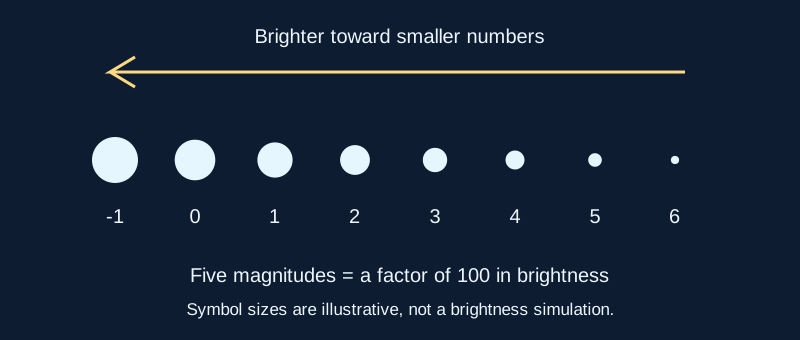
The magnitude scale can seem backward when you first meet it. A smaller number means a brighter object, and some of the brightest things have negative numbers. Once you know the pattern, an observing guide becomes a lot easier to read.
Why brighter stars have smaller numbers
The scale grew out of ancient classifications of visible stars, with the brightest grouped as first magnitude and the faintest as sixth magnitude. Modern astronomy refined that idea into a precise logarithmic scale and extended it to brighter and fainter objects.
Here we're talking about apparent magnitude, how bright an object appears from Earth. Absolute magnitude is a different quantity that compares intrinsic brightness by placing objects at a standard distance.
Each magnitude step is a brightness ratio
One magnitude corresponds to a brightness ratio of about 2.512. A five magnitude difference is exactly a factor of 100. Always compare magnitudes measured in the same band, such as visual V magnitudes.
| Magnitude difference | Approximate brightness ratio |
|---|---|
| 1 | 2.512 |
| 2 | 6.31 |
| 3 | 15.85 |
| 5 | 100 |
| 10 | 10,000 |
Worked example: magnitude 1 and magnitude 6
The difference is 6 − 1 = 5 magnitudes. The magnitude 1 star is 100 times brighter than the magnitude 6 star in the same measurement band. Compare magnitude 1 with magnitude 11 and the ten magnitude difference gives a factor of 10,000.
For any difference, you can use brightness ratio = 10 raised to the power of (0.4 × magnitude difference). Use the positive difference between the two magnitudes, then remember that the smaller magnitude identifies the brighter object.
Zero and negative magnitudes
Magnitude zero is simply a point on the scale. Going from 0 to −1 means getting about 2.512 times brighter. Going from 0 to −5 means getting 100 times brighter.
Sirius is roughly magnitude −1.46. Venus can become brighter than −4. A full Moon is around −12.7, and the Sun is about −26.7 in visual magnitude. Planet and Moon brightnesses vary, so treat these as reference points rather than fixed predictions for an observing date.
The Sun is included here only as a brightness comparison. Never look at it through ordinary binoculars or a telescope without the appropriate purpose designed solar equipment.
Limiting magnitude depends on the night
Limiting magnitude means the faintest stars you can detect under particular conditions. Around magnitude 6 to 6.5 is a useful reference for good unaided viewing under a dark sky, but your eyesight, experience, sky brightness, and atmospheric clarity all affect the result.
Binoculars and telescopes let you see fainter stars. There isn't a guaranteed magnitude limit attached to a particular aperture. A small instrument under a dark sky can be much more rewarding than you might expect.
Why a galaxy can be harder than a star of the same magnitude
A star's light is concentrated into a small image. A galaxy or nebula spreads its light over a larger area. Its total magnitude combines that light, but surface brightness describes how concentrated it is.
M33, the Triangulum Galaxy, is a good example. You can see my image of M33 on AstroBin; a processed photograph will show it differently from the view through an eyepiece. Its total visual magnitude is around 5.7, yet its broad, diffuse glow can be difficult under light pollution. A magnitude 5.7 star is usually a much easier target under the same conditions. A catalog magnitude is a clue, not a promise of visibility.
Try a wide view, give your eyes time to adapt to the dark, and shield yourself from nearby lights. Looking slightly to the side of a faint object, called averted vision, may help. Use field of view to frame a large object, and coordinates to make sure you're looking in the right place.
Further reading
AAVSO's guide to the magnitude system explains the brightness scale. AAVSO's observing profile guide illustrates how observing conditions affect limiting magnitude.