Astronomy for everyone · By Wayne Zuhl
What Does F-Ratio Mean? Telescope Focal Ratio Explained
F-ratio, also called focal ratio and written as f/5 or f/10, is a telescope's focal length divided by its aperture. The number after the slash tells you how many times the focal length is greater than the aperture. For example, f/5 means the focal length is five times the aperture.
"What power is your telescope?" is a perfectly reasonable question, but it doesn't tell us very much about the telescope itself. Change the eyepiece and you change the magnification.
Focal ratio describes a relationship between two properties of the telescope. Understanding those properties helps you make sense of both observing and astrophotography.
Aperture and focal length are different measurements
Aperture is the diameter of the main light collecting lens or mirror. An 8 inch aperture is 203.2 mm, because each inch is 25.4 mm. Aperture affects light gathering and the telescope's ability to resolve fine detail.
Focal length describes the optical system's image scale. In a simple lens system, it's the distance from the lens to the focus for a very distant object. In a telescope with folded optics, the effective focal length can be much longer than the tube.
How to calculate focal ratio
Focal ratio = telescope focal length ÷ aperture
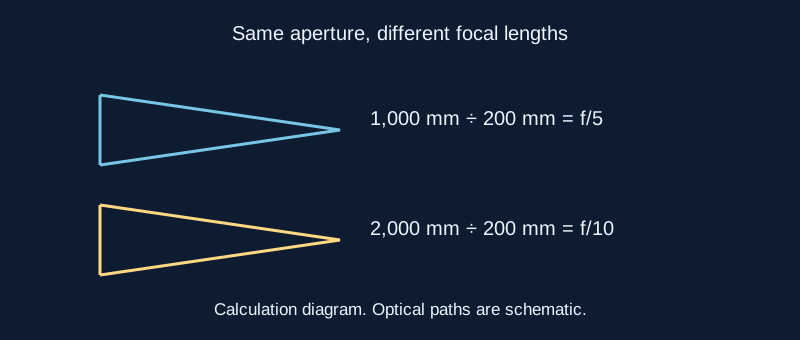
Use the same units for both numbers. A 1,000 mm focal length divided by a 200 mm aperture gives 5, written f/5. The ratio has no unit.
Worked examples from the episode
A standard C8 has a nominal focal length of 2,032 mm and an aperture of 203.2 mm. The calculation is 2,032 ÷ 203.2 = 10, so it is f/10. Its effective focal length can vary with the optical configuration, and a focal reducer changes the system's focal ratio.
For an 8 inch telescope with a 36 inch focal length, the calculation is 36 ÷ 8 = 4.5, giving f/4.5. In millimeters, the same calculation is 914.4 ÷ 203.2 = 4.5. These are the dimensions of my 8 inch Dobsonian, as stated in the episode. An 8 inch aperture by itself doesn't tell you the focal ratio, so check your own telescope's specifications.
What do f/5 and f/10 mean?
An f/5 telescope has a focal length five times its aperture; an f/10 telescope has a focal length ten times its aperture. With a 200 mm aperture, those ratios correspond to focal lengths of 1,000 mm and 2,000 mm. The f-ratio describes this relationship, rather than a fixed magnification.
What lower and higher focal ratios mean for visual observing
At the same aperture, a lower focal ratio means a shorter focal length. With the same eyepiece, that means lower magnification and generally a wider true field. This can be helpful for large star clusters and sweeping the Milky Way.
At the same aperture, a higher focal ratio means a longer focal length. The same eyepiece then produces more magnification, which can be convenient for the Moon, planets, and compact objects.
Those are tendencies, not rules that assign a telescope to only one kind of object. An f/10 telescope can show galaxies, and an f/5 telescope can show planets. Eyepiece choice, optical quality, aperture, and sky conditions all matter.
Does a faster telescope make faint objects brighter?
The terms "fast" and "slow" come from photography. For an extended object recorded at the focal plane with the same camera, a lower focal ratio gives more light per unit sensor area under otherwise comparable conditions. It also changes the image scale, so an exposure comparison needs to account for what you're trying to capture.
At the eyepiece, focal ratio alone doesn't determine brightness. The exit pupil, the beam of light leaving the eyepiece, matters for the surface brightness of extended objects. You can calculate its diameter by dividing aperture by magnification, or eyepiece focal length by focal ratio.
For example, a 20 mm eyepiece at f/5 gives a 4 mm exit pupil. At f/10 it gives 2 mm. The view has changed in both brightness and magnification. At equal exit pupils, comparable telescopes give similar surface brightness for extended objects, though a larger aperture can show them at a larger scale.
Put the numbers to use
Write down your telescope's aperture and focal length, then calculate its focal ratio. Next, use Magnification and Field of View to see what your eyepieces actually do. Choose a setup around the target you want to observe, rather than a focal ratio label alone.
For imaging planning tools, see Resources for Getting Started.
Further reading
Celestron's explanation of focal ratios covers the basic calculation and its photographic meaning.