Astronomy for everyone · By Wayne Zuhl
Measuring the Sky: Degrees, Arcminutes, and Arcseconds
If I tell you that Jupiter is huge, that tells you something about Jupiter. It doesn't tell you how big it will look in your telescope. Think about a mountain in the distance. It can look small from the highway and enormous when you finally get there.
Astronomers use angular measurements to describe what we actually see: the size of an object in our view, or the gap between two objects in the sky.
Angular size and angular separation
Angular size is how much of your view an object occupies. Angular separation is the angle between your lines of sight to two objects. Two stars can look close together while being nowhere near each other in space.
Imagine a great arc from the horizon in front of you, through the point directly overhead, to the horizon behind you. That's 180 degrees. The point overhead, called the zenith, is 90 degrees above the horizon. A full circle around the horizon is 360 degrees.
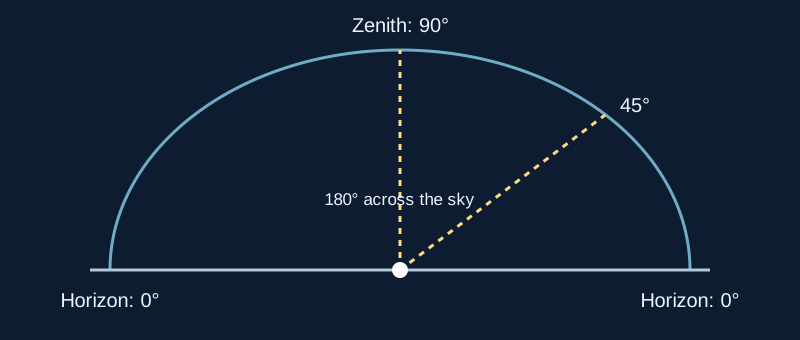
Breaking a degree into smaller pieces
Many objects are much smaller than a degree, so we divide it into smaller units.
| Unit | Equivalent |
|---|---|
| 1 degree, written 1° | 60 arcminutes |
| 1 arcminute, written 1′ | 60 arcseconds |
| 1 degree | 3,600 arcseconds |
An arcminute is an angle, not a minute on a clock. The same distinction applies to arcseconds. You'll meet a different use of minutes and seconds when we discuss right ascension.
The Moon averages about 0.5°, or 30′, across. Its apparent diameter changes a little as its distance changes. Jupiter's disk might be about 40″ across on a particular observing date, but that number also varies. Planetary diameters are commonly listed in arcseconds, although they can be expressed in any angular unit.
Worked example: compare Jupiter with the Moon
Convert the Moon's approximate diameter to arcseconds: 30 × 60 = 1,800″.
Now divide by a sample Jupiter diameter of 40″: 1,800 ÷ 40 = 45.
In this example, the Moon is about 45 times wider in angular diameter. That doesn't mean it's physically larger. It means it occupies a much larger angle in our sky.
Use your hand as a sky ruler
Hold your hand at full arm's length and close one eye. These familiar estimates give you a handy starting point.
| Hand shape at arm's length | Approximate span |
|---|---|
| Width of your little finger | 1° |
| Three middle fingers held together | 5° |
| Width of your closed fist | 10° |
| Thumb to little finger, stretched apart | 20° to 25° |
Hand sizes and arm lengths vary. Use these as rough guides and compare your hand against separations shown in a planetarium program to learn your own scale. Keep your arm extended each time.
If a guide says an object is 20° above the horizon, that's about two fist widths. Measure from the level astronomical horizon; a nearby rooftop or tree line may sit several degrees above it.
Worked example: a comet in an observing guide
Suppose a comet's coma, the fuzzy cloud around its nucleus, is listed as 22′ across, with a tail 10° long. These are example measurements, not a forecast for a current comet.
The coma is 22 ÷ 30, or about 0.73, of the Moon's apparent diameter. The tail spans about one fist width at arm's length. A telescope might show the coma beautifully while fitting only a small section of that long tail into its view.
That's where field of view becomes useful. Knowing an object's size helps you choose a view wide enough to frame it.
Try it on a clear evening
Use your fist to estimate a bright star's altitude. Check your estimate in a sky app set to your location and time. Then compare two bright stars and estimate their separation. You don't need perfect precision. You're building a feel for the scale of the sky.
For another way to use angular measurements, see Finding Objects in the Sky.
Further reading
NASA's Skywatching FAQ explains common sky measurements and hand estimates.