Astronomy for everyone · By Wayne Zuhl
Magnification and Field of View: Choosing Telescope Eyepieces
When I'm looking for an object, I usually start with the widest useful view I can get. Finding a faint fuzzy patch is much easier when I can see the surrounding stars. Once I've found it, I can try a closer look.
Two numbers help us choose that view: magnification and true field of view.
Try the telescope and eyepiece calculator after the explanations below to work out magnification, field of view, focal ratio, and exit pupil for your equipment.
How to calculate magnification
Magnification = telescope focal length ÷ eyepiece focal length
Use millimeters for both values. Most eyepieces have their focal length printed on the barrel.
| Telescope focal length | Eyepiece focal length | Magnification |
|---|---|---|
| 1,000 mm | 40 mm | 25× |
| 1,000 mm | 20 mm | 50× |
| 1,000 mm | 10 mm | 100× |
A shorter eyepiece focal length gives more magnification in the same telescope. If you use a Barlow lens or focal reducer, account for its effect on the effective focal length. A nominal 2× Barlow approximately doubles magnification, although the actual factor can depend on spacing.
Apparent field and true field
Apparent field describes how wide the viewing circle seems as you look into an eyepiece. True field is the actual angular width of sky inside that circle.
Estimated true field in degrees ≈ apparent field in degrees ÷ magnification
An eyepiece with a 50° apparent field at 25× gives an estimated 2° true field. That's about four Moon diameters across, using the Moon's approximate 0.5° diameter.
The same sky at a different magnification
In the episode, I compare a 50° apparent field at 25× with a 100° apparent field at 50×. Both give an estimated 2° true field. The wider apparent field allows a more magnified view of roughly the same patch of sky.
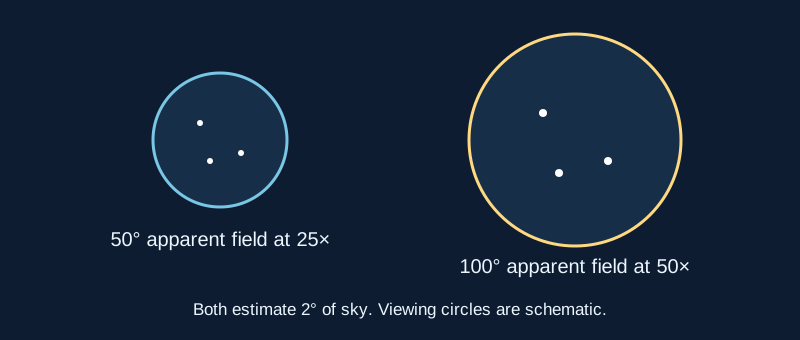
This is an illustrative calculation, not a specification for every 40 mm eyepiece. A typical 40 mm eyepiece in a 1.25 inch barrel cannot deliver the assumed 50° apparent field because of its field stop limit. Check the manufacturer's actual apparent field and field stop. Telescope openings can also limit or dim the outer part of a wide field.
A more reliable field calculation
The field stop is the aperture in an eyepiece that defines the edge of the visible field. If the manufacturer provides its effective diameter, use:
True field in degrees ≈ 57.3 × field stop diameter ÷ telescope focal length
Both lengths must be in the same units. A 27 mm effective field stop in a 1,000 mm telescope gives 57.3 × 27 ÷ 1,000 ≈ 1.55°.
The apparent field shortcut is useful for quick planning, but eyepiece distortion can make it less accurate, especially with very wide apparent fields. Field stop measurements are better for comparing how much sky will actually fit.
Choose the magnification that improves the view
More magnification makes an object larger, but it doesn't create detail the telescope and atmosphere cannot deliver. The image may become softer, shaking more obvious, and tracking more demanding. The surface brightness of an extended object also drops as you increase magnification in the same telescope.
Start low, center the target, and increase power in steps. Stop when the next step makes the view less useful. The best magnification can change from one night to another because seeing, the steadiness of the air, changes.
Check exit pupil too. A 200 mm telescope at 50× gives 200 ÷ 50 = 4 mm. At 200× it gives 1 mm. If the exit pupil is larger than your eye's pupil, some of the telescope's light cannot enter your eye. Focal ratios gives another way to calculate it.
A practical eyepiece plan
Think in terms of a wide view for finding and framing, a middle view for a closer look, and a higher power option for nights when the target and atmosphere support it. You can learn a lot with the eyepieces you already own before buying more.
Compare your calculated field with the sizes in Measuring the Sky. Use a planning tool to preview framing, remembering that a photograph in a simulator can look much brighter and more colorful than the real eyepiece view.
Telescope and eyepiece calculator
Enter the specifications printed on your telescope and eyepiece. All lengths are in millimeters. For inches, multiply by 25.4. The values below are an example; replace them with your own.
True field is an estimate, not a guarantee of an unobstructed view. The field stop method is generally more reliable when the manufacturer supplies an effective field stop diameter. Eyepiece distortion, barrel size, telescope openings, and accessories can limit the usable field. These calculations do not predict image quality or the best magnification for tonight.
Further reading
Tele Vue's eyepiece instructions explain the field stop method. Celestron's Telescope Basics covers magnification and practical telescope use.