Astronomy for everyone · By Wayne Zuhl
Finding Objects in the Sky: Altitude, Azimuth, Right Ascension, and Declination
You know what you want to observe. Now you need to know where to look. Sometimes a direction and a height are all you need. At other times, you want an object's address on a star chart.
Two coordinate systems handle those jobs: altitude and azimuth, and right ascension and declination.
Altitude tells you how high to look
Altitude is the angle above the astronomical horizon. The horizon is 0°, halfway to overhead is 45°, and the zenith is 90°. A negative altitude means the object is below that horizon.
Your local view may have trees, buildings, or hills in the way. An object can be above the astronomical horizon and still be hidden behind them. Use the hand estimates in Measuring the Sky to get a feel for altitude.
Azimuth tells you which direction to face
In the usual astronomy convention, azimuth is measured clockwise around the horizon from true north.
| Direction | Azimuth |
|---|---|
| North | 0° or 360° |
| East | 90° |
| South | 180° |
| West | 270° |
An altitude of 30° and an azimuth of 90° means look about three fist widths above the eastern horizon. This is an example position, not a current location for a specific object. A magnetic compass can differ from true north, and some systems use a different azimuth convention, so check the tool you're using.
Altitude and azimuth depend on your location and the time. As Earth rotates, the same star moves across your local sky. Give a sky app the correct observing location, date, time, and time zone before trusting its directions.
The celestial sphere gives us a common sky map
Imagine the stars placed on a huge sphere around Earth. They aren't really all at the same distance, but the sphere is a useful way to map their directions.
Extend Earth's equator outward and you have the celestial equator. Extend Earth's rotation axis and you have the north and south celestial poles. Polaris sits close to the north celestial pole, but not exactly on it, so it traces a small circle around the pole.
Declination is the sky's version of latitude
Declination, often shortened to Dec, measures angular distance north or south of the celestial equator. The equator is 0°. The north celestial pole is +90°, and the south celestial pole is −90°.
A declination of +30° means 30 degrees north of the celestial equator. It does not mean 30 degrees above your horizon. Those are different measurements.
Right ascension is the sky's version of longitude
Right ascension, or RA, increases eastward around the celestial equator. It is usually written from 0h up to 24h, with 24h wrapping back to 0h. Its traditional zero point is the March equinox direction, where the Sun crosses the celestial equator moving north, in the relevant equatorial reference system.
The full 24h circle corresponds to 360°, so 1h of RA equals 15° measured along the celestial equator. One minute of RA corresponds to 15 arcminutes along the equator, and one second of RA to 15 arcseconds. The hours are an angular coordinate convention. They aren't the time on your watch.
Why right ascension lines get closer together
Think of longitude lines on a globe. They spread apart at the equator and meet at the poles. Right ascension lines do the same on the celestial sphere.
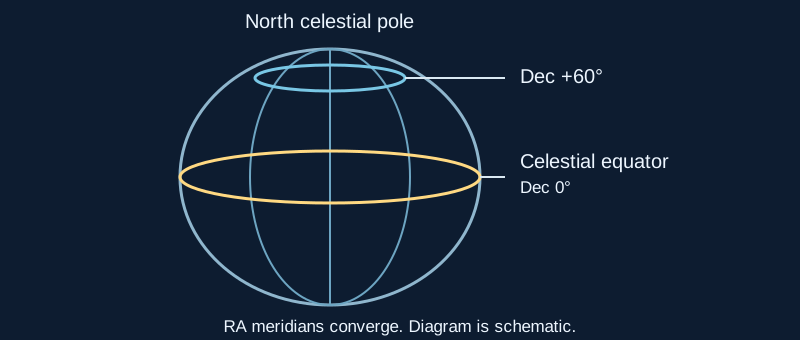
Their angular spacing depends on declination. Your observing latitude changes the orientation of the celestial grid relative to your horizon, but it doesn't change this spacing on the sphere.
For small RA differences between positions at the same declination, sky separation is approximately the RA difference in degrees multiplied by the cosine of declination. Near declination +60°, a small RA interval spans about half the angular distance it would at the equator.
For a 1h RA difference, the arc measured along the +60° declination circle is 15° × cos(60°) = 7.5°. The shortest great circle separation is slightly smaller, about 7.48°. You don't need that calculation to start observing. The useful idea is that equal changes in RA don't produce equal sky separations at every declination.
Worked example: reading M33's coordinates
M33's catalog position is approximately RA 01h 33m 51s, Dec +30° 39′ 37″, J2000. Catalog centers and rounding can differ slightly.
The first number locates it eastward around the celestial equator. The positive declination places it north of the equator. J2000 identifies the coordinate reference used by the catalog. A chart or mount may instead show coordinates adjusted for the current date, so check the expected format before entering a position manually.
An aligned computerized mount can use an object's coordinates to point toward it. Manual setting circles also require the mount to be set up correctly. A coordinate entry doesn't replace alignment.
Start with a chart and a wide view
Choose a bright object first. Find its constellation in a planetarium program, compare the pattern with the real sky, and use a finder or your widest useful telescope view to work toward it. Keep in mind that a telescope may rotate or mirror the chart's orientation.
You can build confidence without memorizing every coordinate. Magnification and Field of View helps you choose a view for finding, while Resources for Getting Started suggests charts and planning tools.
Further reading
The U.S. Naval Observatory's explanation of celestial reference systems describes RA and declination. TheSkyLive's M33 entry lists its J2000 position.