How to Prepare for the Perseid Meteor Shower
The Perseid meteor shower is one of the most reliable and enjoyable sky events of the year.
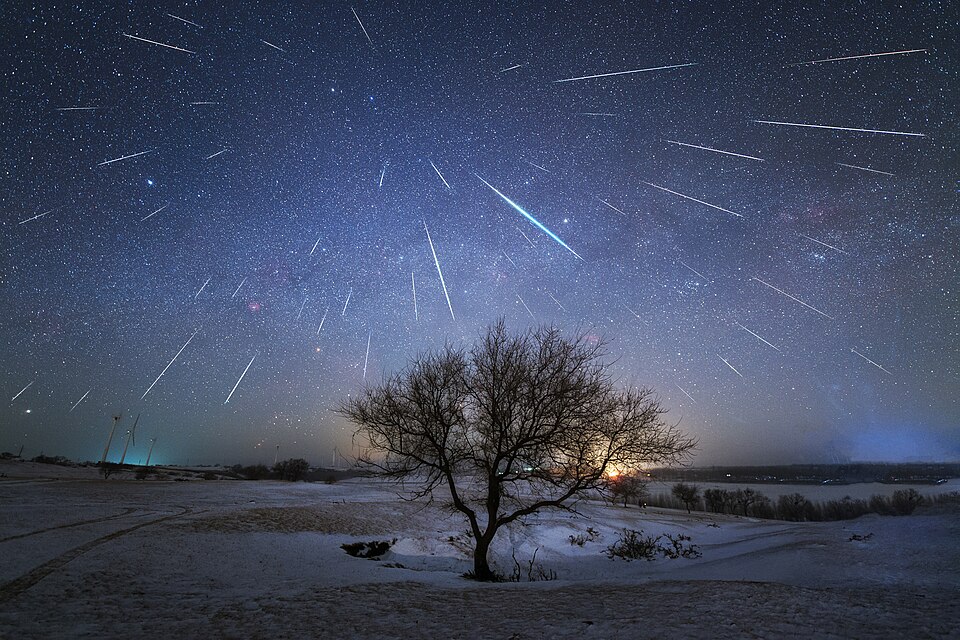
It happens in August, the weather is usually comfortable, and you do not need a telescope to enjoy it. In fact, a telescope is the wrong tool for meteor watching. The best way to watch the Perseids is simple: find a dark place, give yourself time, look up, and be patient.
For 2026, the timing is especially good. The Perseids peak on the night of August 12 into the early morning of August 13, and with the Moon out of the way, this is one of the better setups we can ask for. Under ideal dark-sky conditions, the Perseids can produce a strong display, though backyard numbers are usually lower than the published ideal rates. The American Meteor Society lists the Perseids as a major northern hemisphere shower and gives the 2026 peak as August 12–13.
A Few Days Before the Shower
The most important part of meteor watching happens before you ever step outside.
Start by checking the weather, but do not just look for rain or clouds. Transparency matters too. A perfectly cloudless sky can still be hazy, humid, or smoky, and that can make faint meteors much harder to see.
Next, choose your location. A darker sky is better than a convenient bright one. If you can safely get away from streetlights, shopping centers, porch lights, and headlights, you will see more meteors. Even moving from a brightly lit neighborhood to a darker park, beach, field, or rural road can make a noticeable difference.
Also think about your horizon. You do not need to stare directly at the Perseid radiant in Perseus. Meteors can appear anywhere in the sky. A wide-open view is more important than aiming at one exact spot.
What to Bring
Meteor watching is mostly about comfort. If you are uncomfortable, you won’t stay outside long enough to see any meteors.
Bring a reclining chair or blanket so you can look up without straining your neck. Bring a sweatshirt or light jacket, even in August. When you are sitting still under the night sky, it can feel cooler than you expect.
A good meteor kit does not need to be complicated. The goal is to stay comfortable, preserve your night vision, and give yourself enough time outside to actually catch meteors.
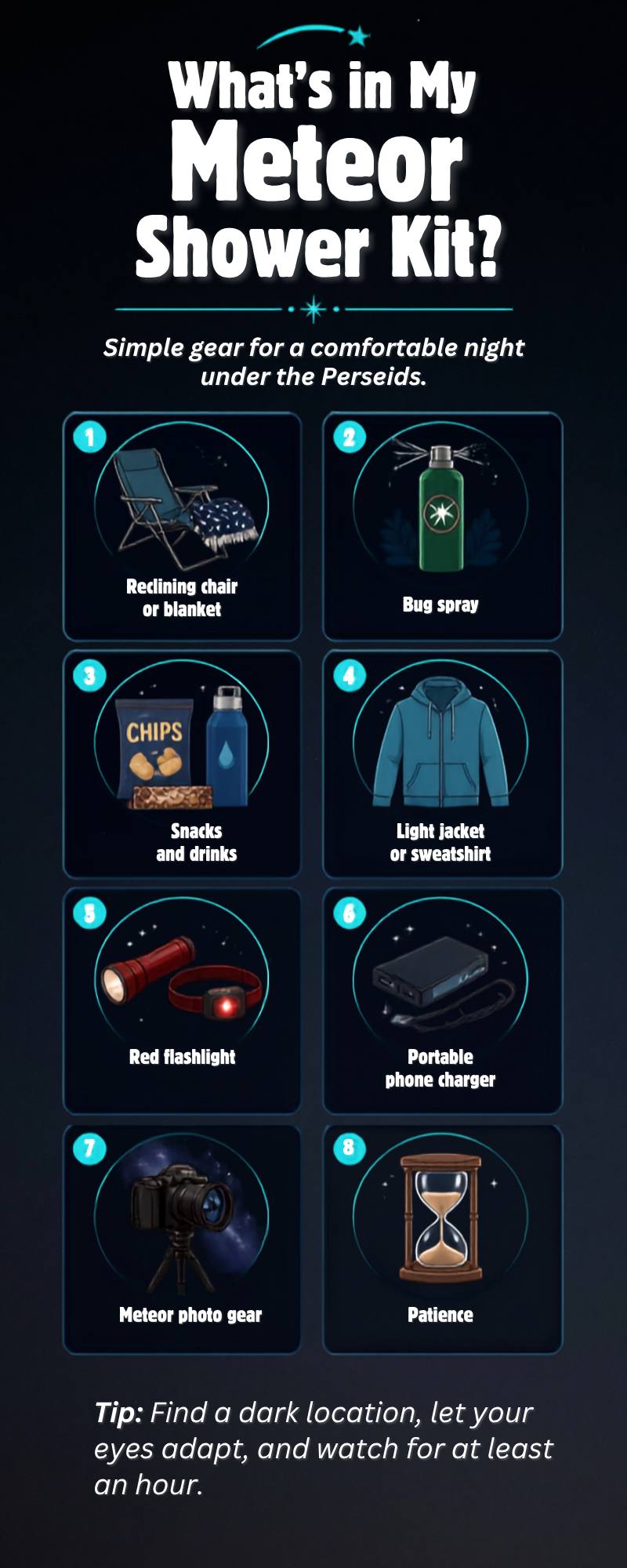
Think comfort first: a reclining chair or blanket, bug spray, snacks, drinks, and a light jacket can make the difference between watching for ten minutes and staying out long enough to enjoy the shower.
A red flashlight or dim red headlamp helps protect your night vision, and a portable phone charger is useful if you are using an astronomy app, checking weather, or running a camera setup.
If you plan to image the shower, bring your camera gear and set it up before the best part of the night begins. And yes, bring patience. Meteors arrive on their own schedule.
The last one matters. Meteors do not appear on command. You may go several minutes without seeing one, then catch two or three in quick succession.
When to Watch
The best time is usually after midnight and into the pre-dawn hours. That is when your part of Earth is turning more directly into the stream of debris that creates the shower.
That does not mean you should skip the evening entirely. You can still see Perseids earlier in the night, and sometimes the earlier meteors can leave longer trails across the sky. But if you want the best chance of seeing more activity, plan for late night into early morning.
For 2026, the prime window is the night of August 12 into the morning of August 13.
Where to Look
This is an instance in astronomy when you don’t want to look through binoculars or a telescope. You want your eyes on as much sky as possible.
Face toward the northeast or east if you are starting earlier in the night. You don’t need to obsess over the exact direction. The Perseids appear to radiate from Perseus, but the meteors can streak across any part of the sky.
A good strategy is to look about halfway up from the horizon, away from the brightest nearby lights, and let your eyes take in a wide area.
Give your eyes at least 20 to 30 minutes to dark adapt. Avoid checking your phone unless the screen is dimmed and red-filtered. One bright glance can set your night vision back.
How to Photograph the Perseids
Meteor photography is a numbers game. You are not trying to react when you see a meteor. By the time you press the shutter, it is already gone.
Instead, set up the camera and let it keep shooting.
The technique most often used is using a tripod mounted camera with a wide-angle lens. A remote or cable release will be helpful and avoid shaky images. You’ll want to test your exposure times and ISO settings in advance.
A good starting setup for a DSLR or mirrorless camera is:
- Camera on tripod
- Wide-angle lens
- Manual focus
- Focus on a bright star
- Aperture wide open or close to it
- ISO 1600 to 3200
- Exposure around 10 to 20 seconds
- Continuous shooting or intervalometer
- RAW format
Take a test shot first. Zoom in on the stars on the camera screen. If they are soft, adjust focus and try again.
If the sky is too bright, lower the ISO or shorten the exposure. If the stars trail too much, shorten the exposure. If the image is too dark, raise the ISO or use a wider aperture.
The goal is not to make every frame perfect. The goal is to collect a lot of frames and hope that some of them catch meteors.
Should You Use a Tracker?
For meteor showers, a simple fixed tripod is usually best.
A star tracker can keep the stars sharp during longer exposures, but it can complicate the landscape and make later processing more involved. Since meteors are brief streaks across the sky, the most important thing is coverage and continuous shooting.
If you want a simple meteor image, use a tripod.
If you want a more advanced composite with tracked stars, meteors, and foreground, that becomes a separate processing project.
Can You Use a Smart Telescope?
A smart telescope is not usually the best tool for meteor showers because most smart telescopes use a narrow field of view. Meteors can happen anywhere in the sky, so a wide-angle camera is usually better.
That said, a smart telescope can still be useful on Perseid night. You can let it image a deep-sky object while you visually watch the meteor shower, or use it earlier in the evening before settling in for meteor watching. I know that the Seestar S30 Pro has a Milky Way Mode, giving a FOV around 65 degrees on the diagonal. That wider field can capture meteors, but a camera on a tripod usually gives you the best chance because it can cover even more sky.
Day-of Checklist
On the day of the shower, keep it simple.
Check the sky conditions. Charge your batteries. Pack before dark. Get to your observing location early enough to set up safely. Let your eyes adapt. Then settle in and give the sky time.
A good plan is:
- Check the weather and transparency
- Pick the darkest safe location you can
- Arrive before peak observing time
- Set up your chair or blanket
- Start your camera sequence, if imaging
- Put the phone away
- Watch for at least an hour
The longer you stay out, the better your odds.
Final Thoughts
The Perseids are one of those events that remind us astronomy doesn’t always require complicated equipment.
Sometimes the best observing setup is a dark sky, a comfortable chair, and enough patience to let the universe do what it does.
For 2026, the Moon gives us a great opportunity. If the weather cooperates, make a plan, get outside, and enjoy one of the best meteor showers of the year.
Clear skies, and Carpe Noctem. Seize the night.