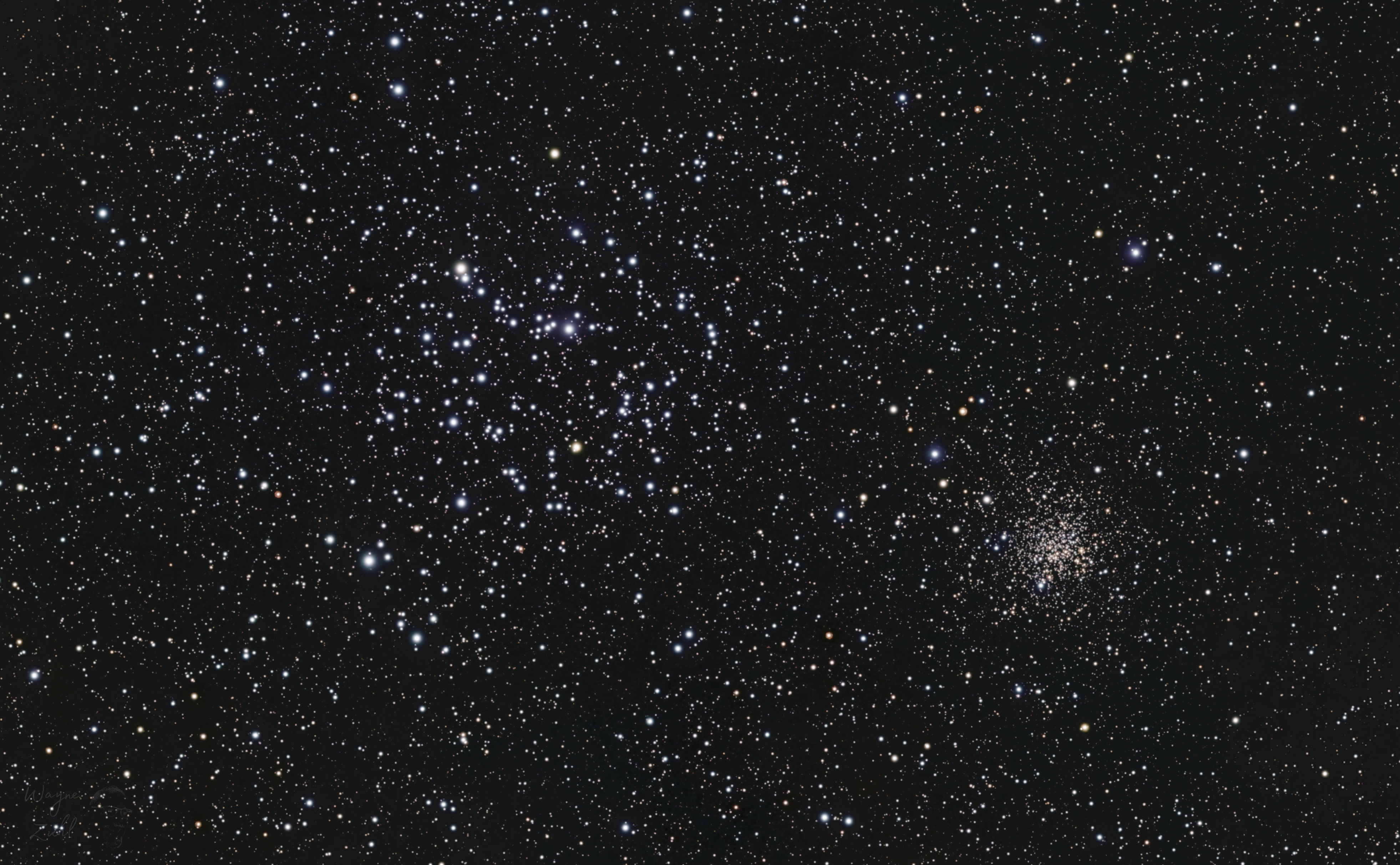
Two Open Clusters in Gemini
M35 is a two-for-one stop in Gemini. The large, loose cluster of bright stars toward the upper left of this image is M35, while the smaller, tightly packed cluster at the lower right is NGC 2158.
M35 contains around 400 stars and lies roughly 2,800 light-years away. It appears about the same size as the full Moon. Most of its brighter stars are blue-white, but look closely and you can pick out a few warmer orange and reddish stars among them.
NGC 2158 appears smaller and fainter, but it is also about four times farther away. It is a much older open cluster, and its warmer, yellowish stars provide a contrast with M35.
How Can You See M35 and NGC 2158?
Under very dark skies, M35 can be picked out without optical aid as a faint, hazy patch. Binoculars show a fuzzy glow with some individual stars, while a telescope resolves many more of its members. A low-power, wide-field eyepiece gives you room to enjoy the cluster and look for its smaller neighbor.
NGC 2158 is the more challenging of the two. Look for a small, faint patch beside M35; the densely packed stars visible in this photograph will be much harder to resolve at the eyepiece.
Behind the Image
This image combines 953 one-minute exposures, for a total integration of 15 hours and 53 minutes. It was captured with a Tele Vue Pronto and ZWO ASI533MC Pro through a UV/IR-cut filter, and processed in PixInsight.
Image Acquisition
- Total integration: 15 hours, 53 minutes
- Exposures: 953 × 60 seconds
- Image type: Broadband, natural color
Equipment and Software
- Telescope: Tele Vue Pronto
- Camera: ZWO ASI533MC Pro
- Mount: Sky-Watcher HEQ5 PRO
- Filter: SVBony UV/IR Cut 2"
- Reducer/Flattener: Tele Vue TRF-2008
- Acquisition: ZWO ASIAIR Pro
- Electronic focuser: ZWO EAF
- Image processing: PixInsight
For a higher-resolution view and additional technical information, visit my image on AstroBin.
About the clusters: NASA’s overview of M35 and NGC 2158.