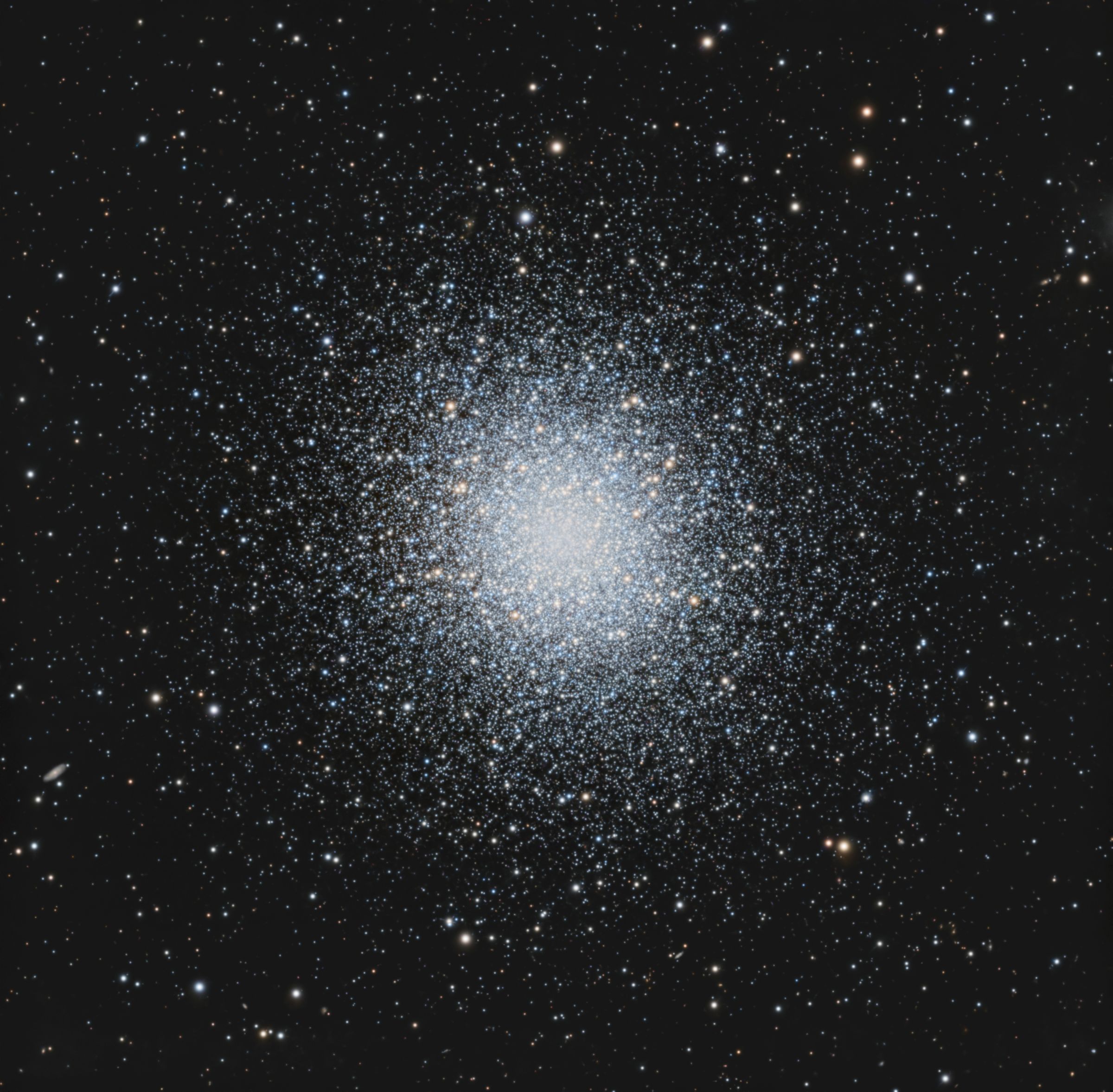
A Deep Look into M13
M13 is a globular cluster in Hercules. This image combines nearly 22 hours of exposure, revealing thousands of individual stars from the densely packed core to the outer reaches of the cluster. Look closely for the faint background galaxies scattered throughout the field.
M13 at a Glance
- Catalog designation: Messier 13 (NGC 6205)
- Object type: Globular cluster
- Constellation: Hercules
- Distance: Approximately 25,000 light-years
- Apparent magnitude: +5.8
- Right ascension: 16h 41m 42s (J2000)
- Declination: +36° 27′ 41″ (J2000)
- Apparent diameter: Approximately 17 arcminutes
- Physical diameter: Approximately 150 light-years
- Best evening viewing: Summer, especially July
Object information: NASA Hubble Messier Catalog.
Edmond Halley discovered M13 in 1714. Charles Messier added it to his catalog in 1764. The cluster contains hundreds of thousands of stars held together by gravity.
How Can You See M13?
Look for M13 about one-third of the way from Eta Herculis toward Zeta Herculis along the western side of the Keystone of Hercules. Binoculars reveal a fuzzy patch, while a small telescope begins to resolve individual stars around its edges. Larger telescopes reveal more of the densely packed stars toward the center.
Behind the Image
This newly processed image combines 1,308 one-minute exposures captured with my Celestron C8 and Optolong L-Quad Enhance filter. The data was processed in PixInsight.
Image Acquisition
- Total integration: 21 hours, 48 minutes
- Exposures: 1,308 × 60 seconds
- Original publication: June 9, 2026
- Reprocessed: November 26, 2026
Equipment and Software
- Telescope: Celestron C8
- Camera: ZWO ASI533MC Pro
- Mount: Sky-Watcher HEQ5 PRO
- Filter: Optolong L-Quad Enhance 2"
- Reducer: Celestron 0.63× SCT Reducer
- Acquisition: ZWO ASIAIR Plus
- Electronic focuser: ZWO EAF
- Image processing: PixInsight
For additional technical information, visit my image on AstroBin.