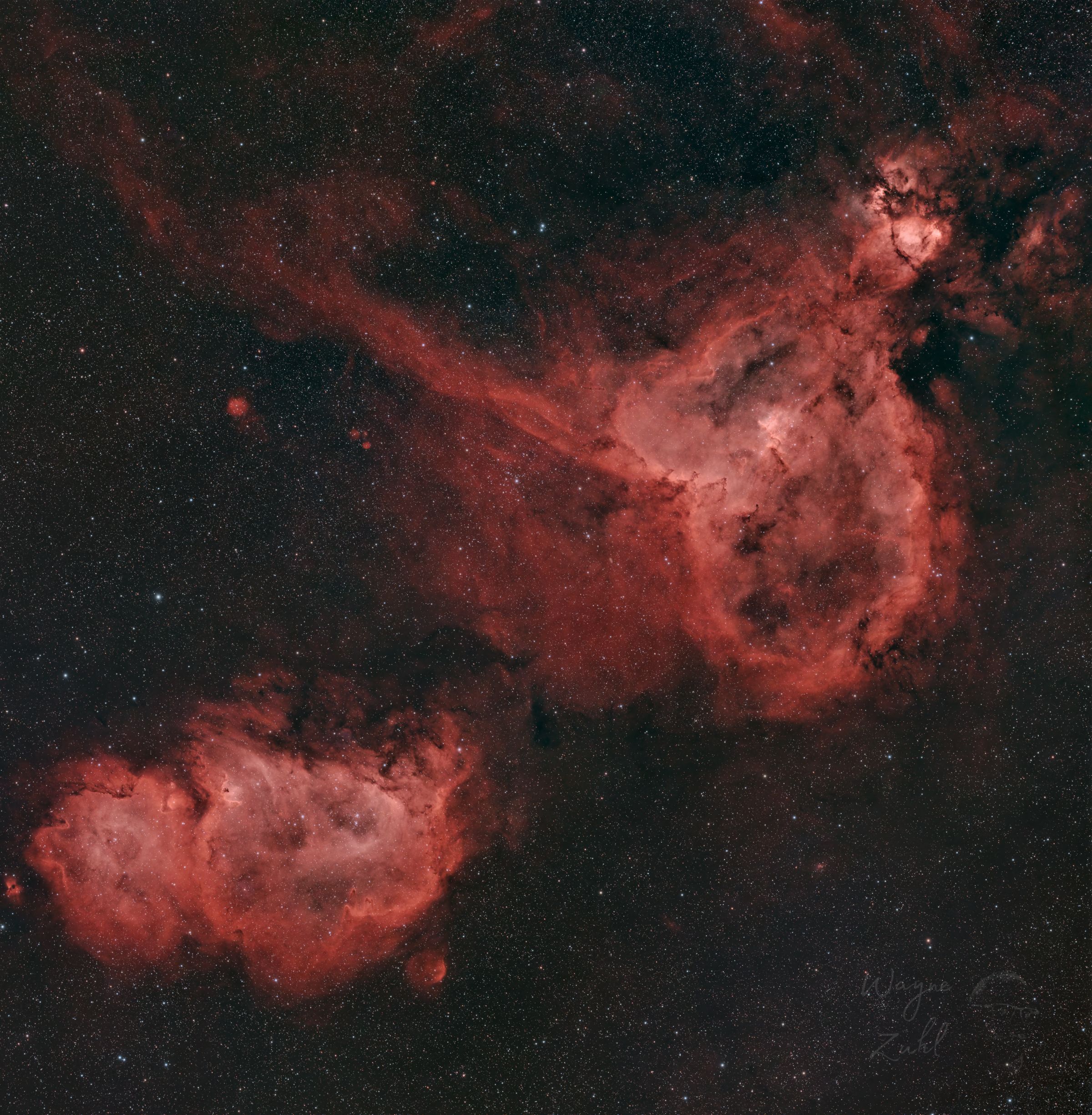
Photographing the Heart and Soul Nebulae Over Two Years
This image is the result of 29 hours and 21 minutes of integration collected over two years from my suburban New Jersey backyard. The project has some personal significance for me as well: it was the first imaging project I started after moving into my new home. I began collecting data in 2025 and returned to the target in September 2026, using the same Samyang 135mm lens and ZWO ASI533MC Pro camera but changing one important part of the imaging system: the filter.
The 2025 data gave me 15 hours and 24 minutes through an Optolong L-eXtreme filter. In 2026, I added another 13 hours and 57 minutes through an Askar ColourMagic D1. The L-eXtreme is a filter I like and have used successfully with other equipment, but with this particular lens it produced prominent halos around several brighter stars. The newer D1 data confirmed that, for my 135mm setup, the Askar filter is simply a better match.
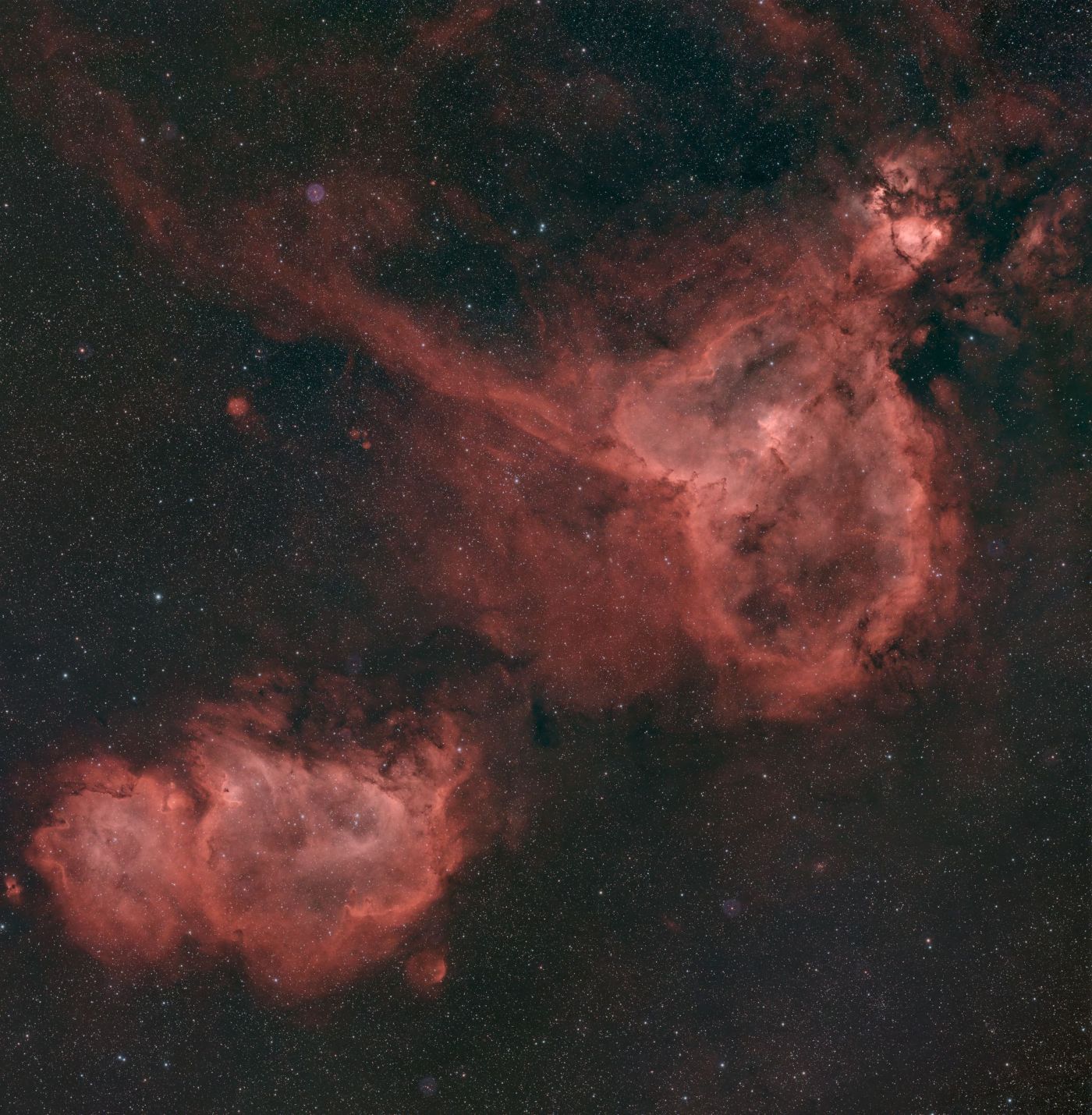
Not wanting to throw away more than 15 hours of otherwise good data, the challenge became finding a way to combine both years’ worth of data while keeping the older halos from dominating the finished image.
Heart and Soul Nebulae in Cassiopeia
The Heart and Soul Nebulae are a vast star-forming complex in the constellation Cassiopeia, roughly 6,000 to 7,000 light-years from Earth. The Heart Nebula is commonly designated IC 1805, while the neighboring Soul Nebula is associated with IC 1848 and W5. Both regions contain young stars whose radiation and stellar winds are shaping the surrounding clouds of gas and dust.
Their large apparent size makes the pair a natural target for a short focal-length lens. At 135mm, both nebulae fit comfortably into the same field while still leaving enough room to show the surrounding hydrogen-rich structures that connect the region.
Gear
- Lens: Samyang 135mm f/2 ED UMC, stopped to f/4
- Camera: ZWO ASI533MC Pro
- Mount: Sky-Watcher HEQ5 Pro
- Filters: Optolong L-eXtreme 2" and Askar ColourMagic D1 Ha+OIII 6 nm 2"
- Control and focus: ASIAIR Plus and ZWO EAF
Image Acquisition
- Total integration: 29 hours 21 minutes
- 2025 L-eXtreme: 15 hours 24 minutes over 3 nights
- 2026 D1: 13 hours 57 minutes over 4 nights
- Camera settings: Gain 100, bin 1×1
- Cooling: −10°C in 2025; 0°C in 2026
- Calibration: 40 darks, 40 flats, 40 flat darks
- Sky: Bortle 6
Processing the Heart and Soul Nebulae in PixInsight
The image was stacked and processed entirely in PixInsight. The biggest challenge was reducing the halos around bright stars in the older L-eXtreme data without damaging the faint nebulosity and structure around them. I worked primarily on the starless image, using a combination of Lighthouse Suite’s Dodge & Burn and Seti Astro’s Blemish Blaster. Rather than making aggressive corrections, I used multiple small passes until the halos stopped drawing attention away from the nebulae.
That processing challenge became one of the most useful lessons from the project: good equipment does not always make a good combination. The L-eXtreme remains a filter I like, but the D1 has proven to be a better fit for this particular fast lens.
See the Heart and Soul Image on AstroBin
The full-resolution project is posted on AstroBin, along with the detailed equipment and acquisition information from all seven imaging sessions.