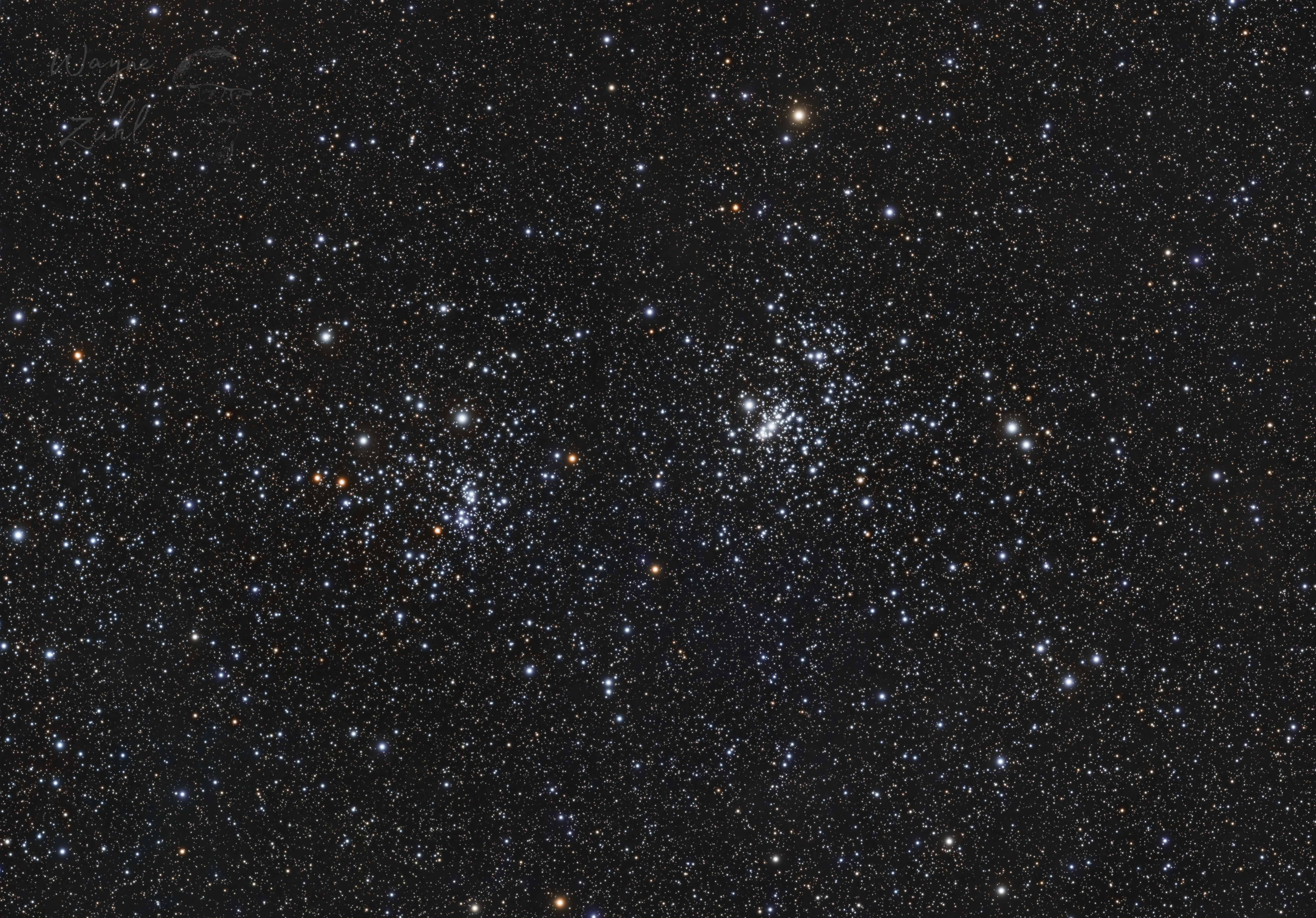
About the Double Cluster
The Double Cluster in Perseus has long been my favorite deep-sky object, both visually and photographically.
Located about 7,500 light-years away, NGC 869 and NGC 884 are two young open star clusters that formed roughly 13 million years ago. Both contain numerous hot, blue-white stars, along with several red supergiants that provide a beautiful contrast in color.
The pair is visible to the unaided eye under dark skies and is a spectacular sight through binoculars. If you're observing with a telescope, I recommend using a low-power, wide-field eyepiece that allows you to see both clusters together.
Behind the Image
I've photographed the Double Cluster many times over the years. With this image, I wanted to go a little deeper and capture more of the rich Milky Way star field surrounding the two clusters.
One of the things I particularly like about this image is the variety of star colors. Since switching to a UV/IR-cut filter with my Tele Vue Pronto, I've been much happier with the appearance and colors of my stars.
Image Acquisition
- Total integration: 17 hours, 27 minutes
- Exposures: 1,047 × 60 seconds
- Image type: Broadband, natural color
Equipment and Software
- Telescope: Tele Vue Pronto
- Camera: ZWO ASI533MC Pro
- Mount: Sky-Watcher HEQ5 PRO
- Filter: SVBONY 2-inch UV/IR Cut
- Reducer/Flattener: Tele Vue TRF-2008
- Acquisition: ZWO ASIAIR Plus
- Electronic focuser: ZWO EAF
- Image processing: PixInsight
For a higher-resolution view and additional technical information, visit my image on AstroBin.