What’s Up in the August 2026 Skies?
August is going to be a busy month for skywatchers.
The summer Milky Way is high in the sky, Cygnus is riding overhead, Venus is bright in the evening, the Perseid meteor shower peaks with almost no Moon in the way, and late in the month, a deep partial lunar eclipse will be visible for much of the Americas.
In this month’s episode of the AstroGuy Podcast, we take a look at all of it, from the planets to the Moon, and then out into the deep-sky treasures of Cygnus.
Venus Dominates the Evening Sky
Venus is the easy planet this month. It shines brightly in the western sky after sunset and reaches greatest eastern elongation on August 15, making this one of the better times to see it in the evening sky.
On August 16, the young crescent Moon passes near Venus, making one of the prettiest naked-eye views of the month. Look west after sunset for brilliant Venus and the thin crescent Moon hanging in the twilight.
Mercury is also visible early in the month before sunrise, but it will be low and challenging. There is a close Mercury-Jupiter pairing on August 15, but both planets will be very low in the dawn twilight, so you’ll need a clear eastern horizon.
Saturn continues to improve in the late-night and morning sky. The Moon passes near Saturn twice this month, around August 4 and again around August 31.
The Perseids Get a Great Moon Setup
The Perseid meteor shower peaks on the night of August 12 into the morning of August 13, and the timing is excellent. New Moon is on August 12, so moonlight will not interfere.
The Perseids have a Zenithal Hourly Rate of about 100 under ideal conditions. That does not mean you will see 100 meteors per hour from your backyard. It assumes dark skies, a high radiant, and a wide-open view of the sky. But with the Moon out of the way this year, it is definitely worth making the effort.
You don’t need a telescope. In fact, a telescope is the wrong tool for meteor watching. Find the darkest sky you can, bring a reclining chair, give your eyes time to adjust, and look at a wide-open part of the sky. After midnight is usually best, and the pre-dawn hours are often better.
Bring drinks, snacks, and a warm layer. Even August nights can feel cool when you’re sitting still for a while.
Two Eclipses in August
August also brings two eclipses.
The first is a total solar eclipse on August 12. Totality will be visible along a narrow path through Greenland, Iceland, northern Russia, the Atlantic Ocean, Spain, and a small part of Portugal. For most of us, this will not be a backyard event, but it is still a major sky event to follow online through NASA maps, coverage, and livestreams.
As always, solar safety matters. If the Sun is not completely covered, you need proper solar eclipse glasses or a properly filtered solar telescope. Sunglasses do not count.
Later in the month, we get a much more accessible eclipse.
On the night of August 27 into the early morning hours of August 28, a deep partial lunar eclipse will be visible for much of the Americas. This is not a tiny little nibble out of the Moon. At greatest eclipse, 93.187% of the Moon’s diameter will be inside Earth’s umbra.
For Eastern Time observers, the partial phase begins around 10:33 p.m. EDT on August 27, reaches greatest eclipse around 12:12 a.m. EDT on August 28, and ends around 1:52 a.m. EDT.
Unlike a solar eclipse, a lunar eclipse is completely safe to watch with your eyes, binoculars, or a telescope. No filters are needed.
Weather permitting, I’m planning to livestream the lunar eclipse, so keep an eye on AstroGuyPod.com and my social media pages as we get closer.
Lunar Feature of the Month: Aristillus and Autolycus
Our Lunar Feature of the Month for August is actually a pair of craters near Mare Imbrium: Aristillus and Autolycus.
Aristillus is the larger of the two, about 55 kilometers across, with central peaks and terraced walls. Autolycus is smaller, about 40 kilometers across, and does not have the same central peak structure. Because they sit close together, they make a nice pair to compare through a telescope.
The best time to observe them is around August 20–24, when the Moon is just past first quarter. That gives you good lighting, with shadows helping to define the crater rims, floors, and central peaks.
Start with Mare Imbrium, the large dark basin in the northern half of the Moon. Find Archimedes near one side of the basin, then look nearby for Aristillus and Autolycus.
Deep-Sky Tour: Cygnus
After the Moon, we head much farther out, into Cygnus, the Swan.
Cygnus is one of those constellations that really feels like summer. It runs through the Milky Way and forms the Northern Cross. Deneb marks the tail of the Swan, Sadr is near the center, and Albireo marks the head.
Before getting to the faint stuff, Albireo is a great place to start. It is a beautiful double star, often described as gold and blue, and it is easy to split in a small telescope.
From there, the episode moves into several Cygnus targets:
M29 is a small open cluster near Sadr, set against a rich Milky Way background.
M39 is larger and looser, and looks best in binoculars or a low-power wide-field telescope.
The North America Nebula, NGC 7000, sits near Deneb. It is a classic imaging target, but visually it can be challenging because it is so large and spread out.
The Pelican Nebula, IC 5070, sits right next to the North America Nebula. Together they make a beautiful wide-field imaging region.
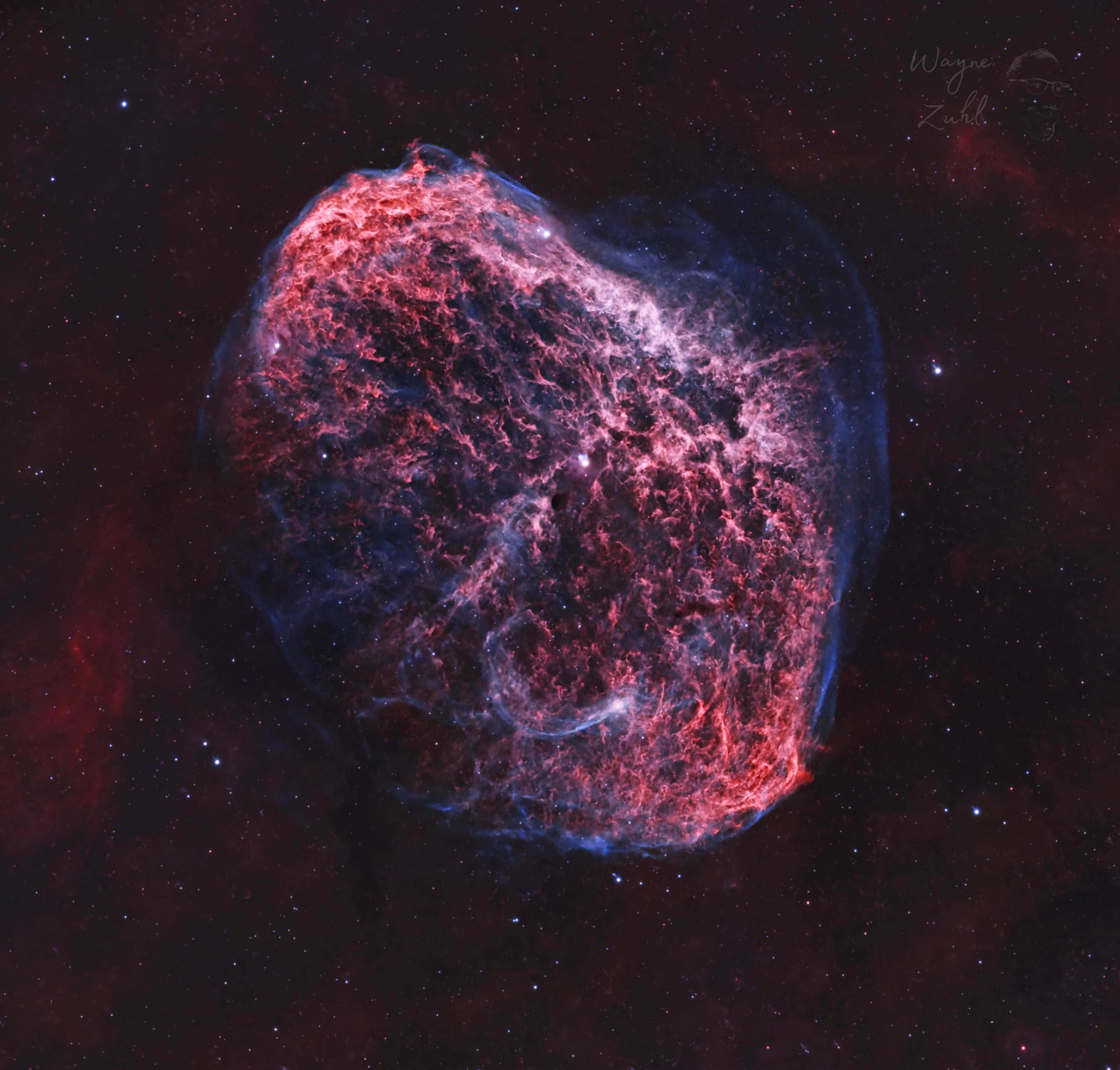
The Crescent Nebula, NGC 6888, is a challenging visual target but an excellent imaging target. With an 8-inch scope and a nebula filter, the brighter parts can show a faint boomerang shape.
The Veil Nebula, part of the Cygnus Loop, is one of the best summer targets. Under dark skies with an OIII filter, the long arcs of nebulosity can be stunning.
The Cocoon Nebula, IC 5146, sits with the dark nebula Barnard 168. It is another target that is especially rewarding for imagers.
Cygnus is one of those constellations where you can spend the entire night observing. It has delights for binoculars, telescopes, and imagers.
Download the August 2026 Observing Guide
The full August 2026 AstroGuy Observing Guide is available at AstroGuyPod.com. It includes best observing windows, a Moon phase calendar, planetary data, eclipse and meteor notes, Lunar Feature of the Month details, the Cygnus target list, finder chart links, and quick field tips.
August gives us a deal to enjoy this month, so get outside, look up, and enjoy the sky.
Carpe Noctem. Seize the night!